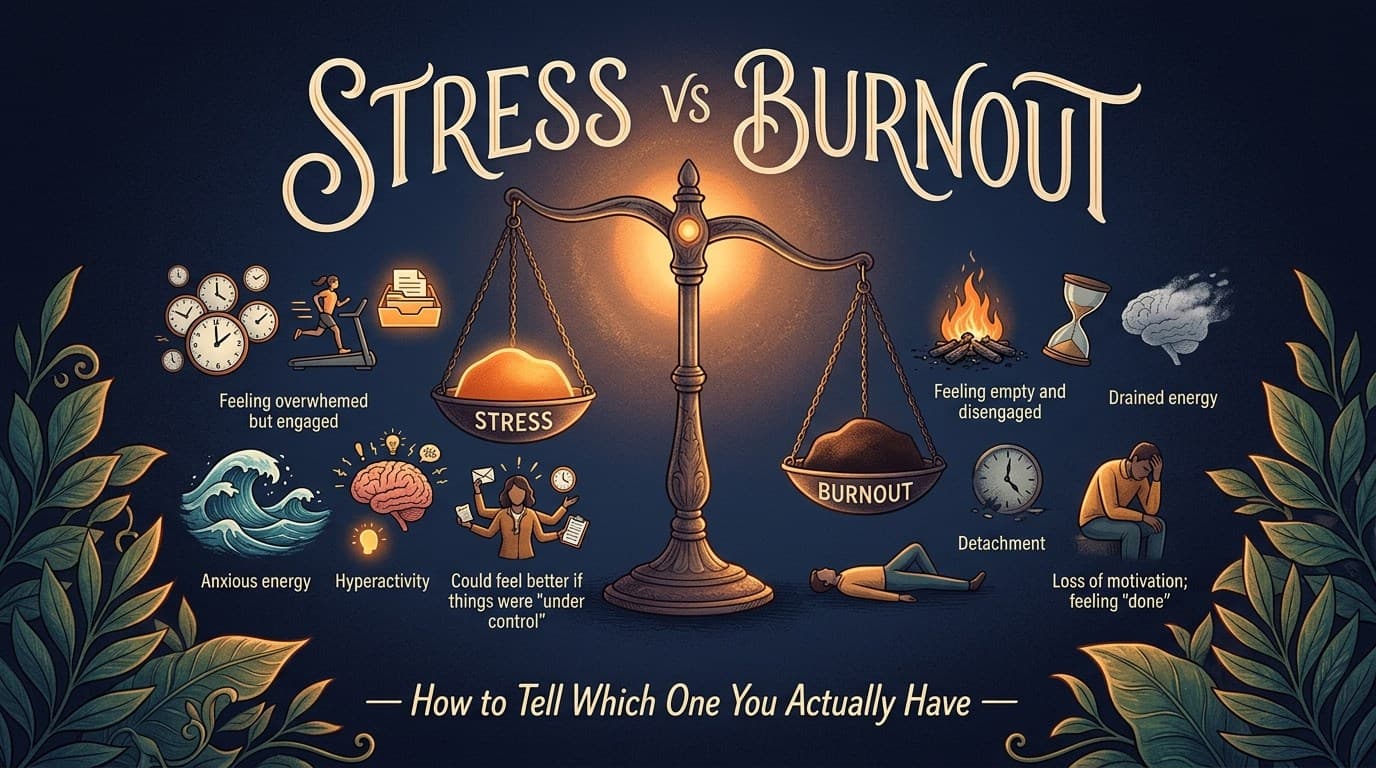
Burnout advice has a dirty secret: most of it quietly assumes you can stop. Take a sabbatical. Go part-time. Step back for a season. For the majority of people in burnout — with rent, mortgages, children, visas tied to employment — this advice is useless. The actual question is harder and far more common: how do you recover from burnout while continuing to do the thing that burnt you out?
It is possible. It is slower than the sabbatical version, and it requires being more ruthless about a small number of things rather than vaguely gentler about everything. Here is the realistic playbook.
First, Confirm What You're Dealing With
Recovery-while-working only works if you target the right condition. Burnout is not just exhaustion — it's exhaustion plus cynicism plus a collapsed sense of effectiveness, built over months. If you haven't already, read our guide to telling stress and burnout apart, because ordinary (if severe) stress responds much faster and to different moves.
And one screening note before anything else: if your flatness extends to everything — not just work — or sleep, appetite, and any capacity for pleasure have been gone for weeks, see your GP first. Burnout and depression overlap, and depression has treatments that no workload adjustment can substitute for.
The Recovery Myth You Need to Drop
The myth: recovery requires removing the stressor. The reality: recovery requires changing the ratio between depletion and restoration. A sabbatical changes the ratio by zeroing out depletion. But the ratio also moves when you reduce depletion by 20% and triple your (currently near-zero) restoration. That's the entire strategy. Everything below serves one side of that ratio or the other.
Step 1: Triage — Find the Two Things Doing Most of the Damage
Burnout feels like everything is crushing you, but depletion is rarely evenly distributed. In practice, two or three specific things usually account for most of the damage: a particular meeting load, one relationship, being on-call, a project that has lost all meaning, the 10pm email habit.
Write the actual list. Rank it by how much each item costs you, not how big it looks. Then aim every hard conversation and every boundary at the top two items only. This is the opposite of generic self-care, which spreads tiny improvements evenly across an unchanged life — and is why generic self-care fails against burnout.
Step 2: Cut Inputs, Not Just Hours
Most people in burnout cannot cut many hours. Almost everyone can cut inputs — and the depleted nervous system cares about both:
- Notifications: Off, except genuinely operational ones. Every ping is a micro-mobilisation your system pays for.
- Response-time expectations: The most renegotiable boundary nobody renegotiates. "I check messages at 9, 1, and 4" survives almost every workplace.
- Meetings without a defined purpose for you: Ask for the notes instead. A surprising fraction of meeting load is declinable once you actually try.
- The commute scroll, the lunch scroll, the lift scroll: These feel like rest. They're input. Depleted systems need genuinely low-input minutes, not different stimulation.
Step 3: Install Micro-Recovery — the Part That Feels Too Small to Matter
Within an unchanged work schedule, recovery has to happen in small doses, frequently. The research is friendlier here than people expect — a 2022 meta-analysis of micro-breaks found that breaks of ten minutes or less reliably reduce fatigue and restore energy. We've written a full guide to micro-breaks, but the burnout-specific essentials:
- One protected ten-minute break, mid-morning and mid-afternoon. Outside if possible. Not coffee-while-reading-Slack — actual disengagement.
- A daily regulation practice, ten minutes, non-negotiable. Breathwork or mindfulness — the nervous system tools that lower baseline arousal. In burnout this is not a luxury; it's how you stop the depletion side of the ratio compounding overnight.
- A real lunch, away from the desk, at least three days a week. Mundane and disproportionately effective.
None of these feel powerful. Their power is arithmetic: 30–40 minutes of genuine restoration daily, every day, for months — versus the zero you're currently running.
Step 4: The Boundary Conversation (a Script)
At some point recovery-while-working requires telling someone with power over your workload that something has to change. Most people delay this until resignation feels easier. Have it earlier, and have it like this:
"I want to keep doing good work here, and I've noticed my capacity has been running past its limit for a while. To keep performing well I need to change X — specifically [one concrete thing: handing off the Henderson account / not being on-call two weeks per month / a deadline review on the migration project]. Can we work out how to make that happen?"
Note the structure: commitment first, problem framed as capacity (not complaint), one specific request (not "less stress"), collaborative close. You are far more likely to get one concrete thing than a general reduction — which is why the triage in Step 1 matters. Ask for the thing at the top of the list.
Step 5: Reconnect With Why — Carefully
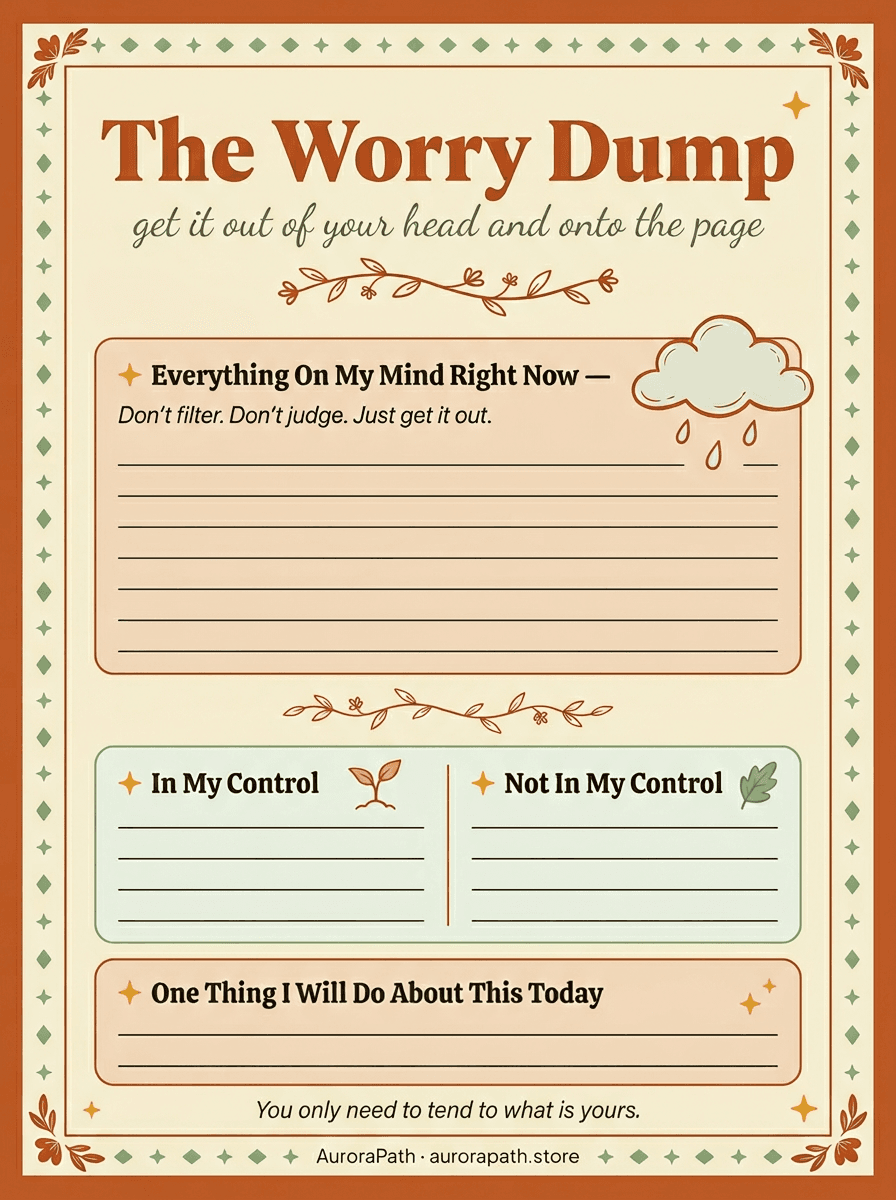
The cynicism dimension of burnout doesn't respond to rest at all; it responds to meaning. But "find your passion again" advice lands as insulting when you're depleted. The gentler, more honest version: once the exhaustion has eased slightly (and only then), spend some reflective time — journaling works well — on two questions: Which parts of this work, however small, still feel like mine? Which values of mine has this job been violating? The first rebuilds connection. The second often clarifies whether this is a recover-in-place situation or a leave-when-ready situation. Both are legitimate outcomes.
The Honest Timeline
Recovering while working takes months — commonly three to six before things feel meaningfully different, sometimes longer if the conditions barely budge. Progress is also non-linear: better weeks, then a regression after a heavy stretch. That's the normal shape, not failure.
What you should see if the plan is working: by week four or so, slightly faster recovery after hard days. By two or three months, moments of actual engagement returning. The caring comes back last — and when you notice it returning, that's how you know the ratio finally flipped.
The daily-practice scaffolding for this kind of recovery is exactly what Find Your Ground — AuroraPath's 30-day mindfulness journal for adults — provides: fifteen structured minutes a day across one month, starting with pure nervous-system regulation. Our free collection of 10 mindfulness worksheets is also an instant free download at aurorapath.store.
From the AuroraPath Store
Grow Calm
A 30-day mindfulness challenge for kids aged 7–11. 96 beautifully illustrated pages — instant download.
$15.99
Get Grow Calm →Instant PDF download · Print at home
Alex Ewing
Creator of AuroraPath
Alex Ewing created AuroraPath to make premium mindfulness resources accessible for every family. Grow Calm is the first book in the AuroraPath collection.