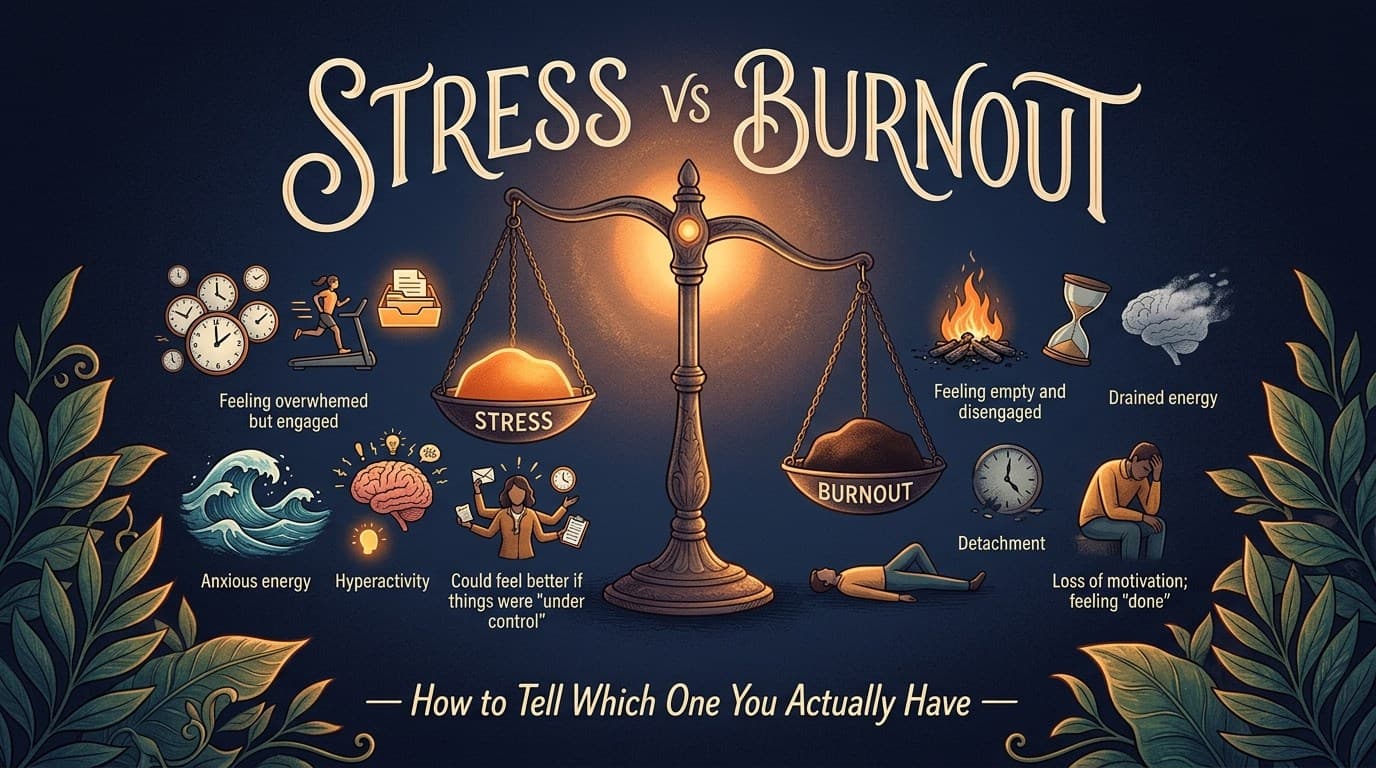
There is a moment most of us know well: you are wound up — heart going, jaw tight, thoughts looping — and someone (possibly you) suggests just calming down. It doesn't work. It has never worked. And there's a physiological reason why.
When your stress response is fully activated, the brain regions responsible for calm rational perspective are exactly the ones being suppressed. Trying to think your way down from a flooded state is like trying to fix the engine while the car is moving. The body has to slow first. Then the thinking comes back online by itself.
That is what nervous system regulation means in practice: working with the body directly, using inputs the autonomic nervous system actually responds to. Here's the plain-English version of how it works, and eight exercises ranked roughly by speed.
The Two-Branch System, Briefly
Your autonomic nervous system has two main branches. The sympathetic branch is the accelerator — it mobilises you for action, floods you with adrenaline and cortisol, raises heart rate, sharpens focus, and narrows attention. The parasympathetic branch is the brake — it slows the heart, restores digestion, and signals safety.
Neither is good or bad. The problem of modern life is that the accelerator gets pressed constantly — by deadlines, notifications, traffic, news — while the brake rarely gets deliberate use. Regulation exercises are deliberate brake practice. Some work in seconds. Others build a calmer baseline over weeks.
Fast: For the Moment You're Activated
1. The physiological sigh. Two inhales through the nose — one full breath, then a second short sniff on top — followed by a long, slow exhale through the mouth. Repeat two or three times.
This is currently the fastest evidence-supported breathing intervention we have. A 2023 Stanford trial published in Cell Reports Medicine compared five minutes a day of this "cyclic sighing" against box breathing and mindfulness meditation — the sighing produced the largest improvements in mood and the biggest drop in breathing rate, with effects that grew over a month of practice. The mechanism: the double inhale pops open collapsed air sacs in the lungs, and the long exhale that follows produces an immediate parasympathetic response.
2. Long exhales. If the double-inhale feels fiddly, just make your exhale longer than your inhale — in for four, out for eight. Heart rate naturally rises slightly on the inhale and falls on the exhale; extending the exhale extends the slowing phase. Sixty seconds of this changes how your body feels.
3. Cold water. Cold water on the face — or holding your wrists under a cold tap for thirty seconds — triggers the mammalian dive reflex, which rapidly slows heart rate. It is blunt, unsubtle, and remarkably effective in moments of acute activation.
4. Orienting. Slowly turn your head and let your eyes wander around the room, landing on whatever draws them — colours, shapes, light. This sounds like nothing. It works because scanning the environment and finding no threat is the oldest safety signal the nervous system has. Thirty seconds of genuine looking tells an activated system: nothing here requires mobilisation.
Medium: For the Wound-Up Afternoon
5. Humming. Long, low humming on the exhale — a minute or two. The vibration stimulates the vagus nerve, the main highway of the parasympathetic system, and the breath control required makes shallow chest-breathing impossible. (This is also one of the most kid-friendly tools we know — it anchors one of the exercises in our guide to breathing exercises for anxious kids.)
6. Shaking and movement. Stand up and literally shake out your arms, legs, and shoulders for sixty seconds, or take a brisk five-minute walk. Activation is mobilised energy — the body has prepared you to do something. Doing something physical, even something pointless, completes the cycle and lets the system stand down. This is often more effective than stillness for people whose anxiety spikes when they sit quietly.
7. Progressive muscle release. Tense your shoulders hard for five seconds, then release completely. Then hands. Then jaw. The contrast between deliberate tension and release teaches the body the difference — and most of us are carrying tension we stopped noticing years ago.
Slow: Building a Calmer Baseline
8. A daily regulation practice. The seven tools above are rescue tools. They work in the moment, and the moment matters. But the deeper change — a system that activates less easily and recovers faster — comes from daily practice over weeks and months. Ten minutes of breathwork, body scanning, or mindful attention each day measurably shifts baseline heart rate variability and reduces reactivity. Our article on emotional regulation covers the science of why repetition, not intensity, is what changes the system.
The honest framing: in-the-moment tools are like bailing water; daily practice is fixing the hull. You need both, but only one of them changes the trajectory.
A Note on What Regulation Is Not
Regulation is not suppression. The goal is not to never feel activated — activation is healthy, useful, and frequently appropriate. The goal is a system that can come back down when the situation no longer needs it, instead of idling at 70% arousal all day, every day.
And if your baseline never seems to come down — if you feel activated or numb most of the time regardless of circumstances, or your sleep has been disrupted for months — that is worth a conversation with your GP. Chronic dysregulation has medical causes and medical supports, and the tools in this article work best alongside them, not instead of them.
If you want regulation built into a daily structure rather than a list you have to remember, Find Your Ground — AuroraPath's 30-day mindfulness journal for adults — dedicates its entire first phase to exactly these practices, one guided day at a time. Our free collection of 10 mindfulness worksheets is also available as an instant free download at aurorapath.store.
From the AuroraPath Store
Grow Calm
A 30-day mindfulness challenge for kids aged 7–11. 96 beautifully illustrated pages — instant download.
$15.99
Get Grow Calm →Instant PDF download · Print at home
Alex Ewing
Creator of AuroraPath
Alex Ewing created AuroraPath to make premium mindfulness resources accessible for every family. Grow Calm is the first book in the AuroraPath collection.