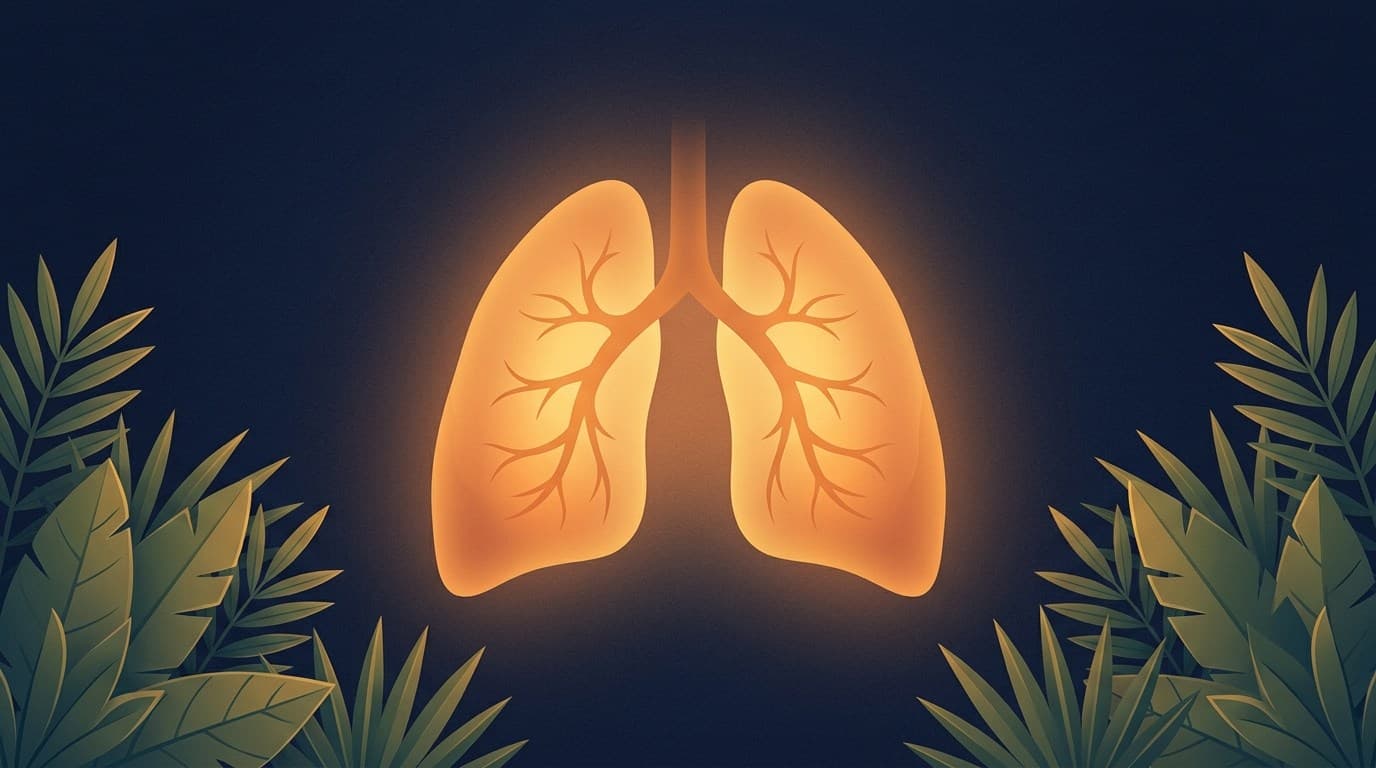
"Take a deep breath" sits in a strange category of advice: universally given, frequently mocked, and — inconveniently for the mockers — backed by some of the most solid physiology in the entire wellbeing space.
Breathing exercises work. Not as a placebo, not as a distraction, but through a specific, well-mapped mechanical pathway between your lungs and your nervous system. This article explains that pathway in plain English: what the vagus nerve actually does, why the exhale is the active ingredient, and what one of the best recent studies found when it compared techniques head-to-head.
The One-Sentence Version
Breathing is the only major function of the autonomic nervous system that you can also control voluntarily — which makes it a manual override lever for a system that otherwise ignores your opinions.
You cannot decide to lower your heart rate. You cannot choose to reduce your cortisol. But you can change your breathing — and because breathing is wired into the systems that control heart rate and stress chemistry, changing it changes them. The breath is a side door into machinery you can't access directly.
Meet the Vagus Nerve
The vagus nerve is the longest nerve of the autonomic nervous system, wandering (the name literally means "wandering") from the brainstem down through the throat, heart, lungs, and gut. It is the main highway of the parasympathetic system — the "rest and digest" branch that slows the heart, calms the body, and signals safety.
The vagus is not a one-way road. Around 80% of its fibres carry information upward, from body to brain. This is the detail that explains everything: your brain is constantly reading the body's state to decide how alarmed to be. A fast-breathing, tight-chested body reports emergency. A slow-breathing body with long exhales reports safe. Change the report, and the brain updates its threat assessment.
This is why "calm down" fails but breathing works. One argues with the brain. The other changes the evidence.
Why the Exhale Is the Active Ingredient
Here is a piece of physiology you can feel right now. Your heart rate is not constant — it rises slightly with every inhale and falls slightly with every exhale. (The technical name is respiratory sinus arrhythmia, and far from being a problem, a strong version of this rhythm is a marker of a healthy, flexible nervous system — it's the basis of heart rate variability, or HRV.)
Inhales are mildly activating. Exhales are mildly calming — the vagus applies the brake on every out-breath.
Breathing techniques exploit this asymmetry. When you extend the exhale — out for eight after in for four — you extend the braking phase of every breath cycle. Do that for two minutes and you've applied the brake dozens of times in a row. The heart slows. The upward-travelling vagal fibres report the slowdown. The brain reads the report and dials down the alarm. None of this requires belief, which is why it works on sceptics and seven-year-olds alike.
What the Research Shows — the Stanford Comparison
For years, breathing studies tested one technique against nothing. More useful is testing techniques against each other, which is what a 2023 Stanford trial published in Cell Reports Medicine did. Researchers (including psychiatrist David Spiegel and neuroscientist Andrew Huberman) randomised 114 people to five minutes a day of one of four practices for a month: cyclic sighing, box breathing, cyclic hyperventilation, or mindfulness meditation.
The winner, by a meaningful margin, was cyclic sighing — the "physiological sigh" pattern of two nasal inhales (one big, one small sniff on top) followed by a long mouth exhale. It produced the largest improvement in daily mood and the biggest reduction in resting breathing rate, and its benefits grew with each week of practice. Notably, it outperformed mindfulness meditation of identical duration for mood improvement.
Why this pattern? The double inhale re-inflates alveoli — tiny air sacs in the lungs that collapse under stress and shallow breathing — allowing the subsequent exhale to offload carbon dioxide more efficiently. And the deliberately long exhale is, as above, pure vagal brake. You may recognise the pattern from life: it's the same breath your body produces spontaneously at the end of a long cry, and roughly what happens when a child finally settles after sobbing. The technique is borrowed from the body's own repertoire.
Box Breathing, 4-7-8, and the Kids' Versions
Do the other patterns work? Yes — just through the same one or two mechanisms in different proportions. Box breathing (4-4-4-4) adds rhythmic predictability, which is itself regulating. The 4-7-8 pattern is essentially a long-exhale technique with a hold that lets CO₂ rise slightly, deepening the subsequent calm. Slow diaphragmatic breathing improves HRV with practice.
The mechanism is also age-blind, which is why breathing tools are the foundation of children's emotional regulation programmes. Kids' versions just wrap the physiology in story — "balloon breathing," humming like a bee (which adds vagus-stimulating vibration), blowing out birthday candles. Our guide to breathing exercises for anxious kids covers five of them, and the same science explains every one.
How to Choose, Practically
- Acute stress, right now: physiological sigh — two or three rounds. Fastest onset in the research.
- Wind-down for sleep: 4-7-8 or simple long exhales — see our guide to mindfulness for better sleep.
- Building a calmer baseline: five minutes daily of any slow-breathing practice, where consistency matters far more than which pattern you pick. The Stanford effects grew over 28 days — this is a dose-dependent tool.
One honest caveat: breathing techniques are regulation tools, not treatments. They lower the temperature of moments; they don't resolve clinical anxiety on their own. If anxiety is loud most days, the right move is professional support — with breathwork as the excellent companion it is.
If you want breathwork built into a structured daily practice — with the science explained as you go — Find Your Ground, AuroraPath's 30-day mindfulness journal for adults, opens its first phase with exactly these tools. Our free collection of 10 mindfulness worksheets, including breathing exercises for all ages, is an instant free download at aurorapath.store.
From the AuroraPath Store
Grow Calm
A 30-day mindfulness challenge for kids aged 7–11. 96 beautifully illustrated pages — instant download.
$15.99
Get Grow Calm →Instant PDF download · Print at home
Alex Ewing
Creator of AuroraPath
Alex Ewing created AuroraPath to make premium mindfulness resources accessible for every family. Grow Calm is the first book in the AuroraPath collection.