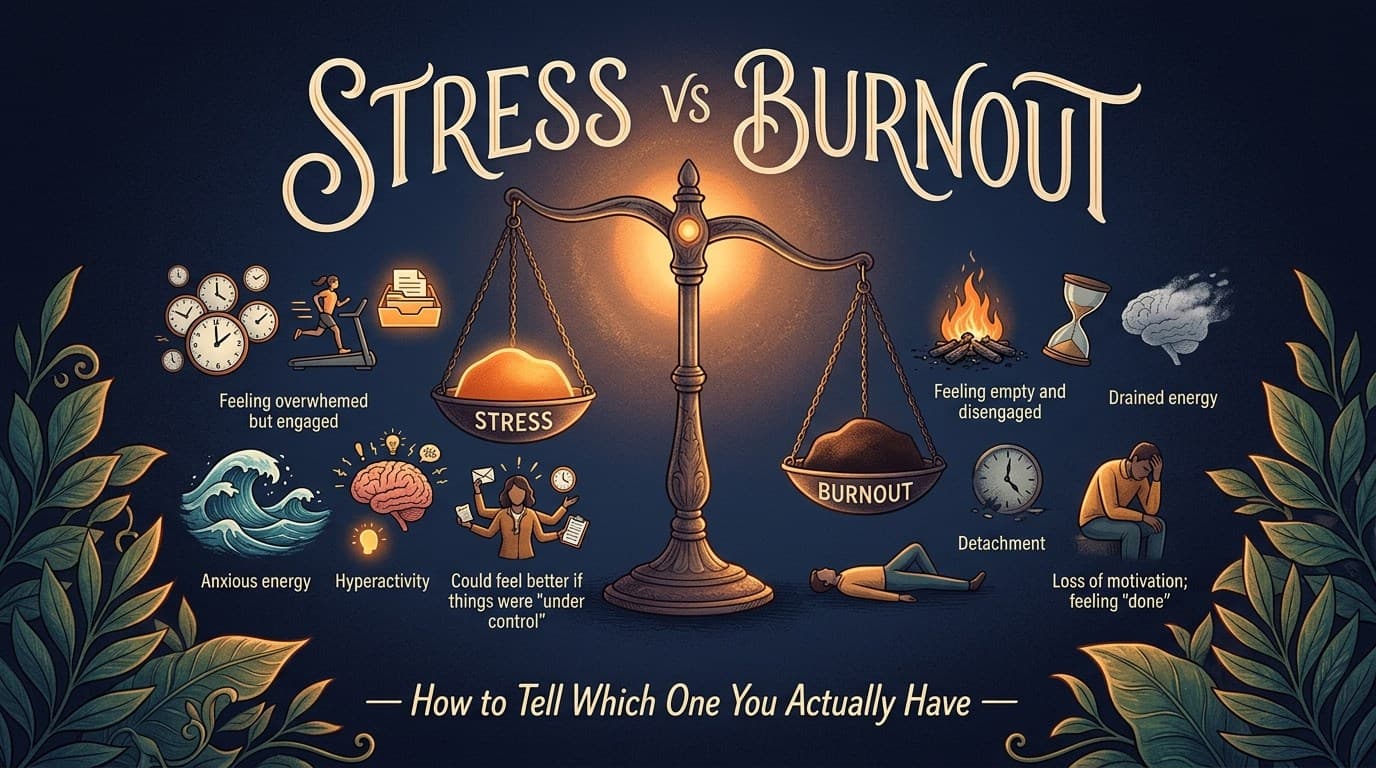
The word "boundaries" has a branding problem at work. It sounds confrontational — like something you declare, dramatically, possibly while a meeting falls silent. So most people never set any, and instead run the quiet alternative: absorbing everything, resenting much of it, and slowly burning down. (If that trajectory sounds familiar, our guide to stress versus burnout is the companion read.)
Here's the reframe that makes boundaries actually settable: a boundary is not a confrontation. It's capacity management, stated out loud. You have finite hours and attention; a boundary is simply accurate information about how they're allocated. Framed that way — and worded that way — most boundaries turn out to be surprisingly acceptable to the people on the other side, because clarity is easier to work with than silent overcommitment followed by missed deadlines.
The Principle Under All the Scripts
Every workable boundary script has the same skeleton: acknowledge + state the constraint + offer what you can do. Not justification (over-explaining invites negotiation), not apology theatre (one "unfortunately" maximum), not blame. Just: I hear you, here's the reality, here's the workable version.
The third element matters most. A flat "no" leaves the other person holding a problem; "no, but here's what would work" makes you the person who solved it within constraints — which is, inconveniently for martyrs everywhere, how reputations are actually built.
The Script Library
Declining a request (the clean no): "I can't take this on right now — my plate's full through [date] with [project]. If it can wait until then, I'm happy to pick it up." No fictional excuses; the constraint is the reason. Fictional excuses get audited.
Declining when it's your manager (the priority trade): "Happy to take that on. Currently I'm on X and Y — which one should this come ahead of?" This is the single most useful sentence in working life. You haven't said no; you've made the capacity maths their decision, which is where it belongs. Repeated calmly, it also trains the requester that your hours are a ledger, not a well.
Renegotiating a deadline (early, not at the cliff): "Flagging early: [task] won't be done well by Thursday. I can do a solid version by Monday, or a rough-cut Thursday if you need something to react to — which is more useful?" Early flags with options read as professionalism. Friday-afternoon surprises read as failure. Same facts, different timing.
The meeting decline: "I don't think I'm needed for the whole session — could I join for the [topic] section, or just get the notes?" Calendar archaeology shows most recurring meetings survive on politeness alone.
The scope-creep catch: "That's beyond what we scoped — happy to look at it as a follow-on piece. Want me to estimate it separately?" Cheerful, immediate, and it converts creep into visible work instead of invisible absorption.
Async Boundaries: Where Modern Overload Actually Lives
For most knowledge workers, the heaviest leak isn't big requests — it's ambient availability: pings answered at 9pm, the inbox checked from bed. Two structural moves:
Set response-time expectations explicitly, once. "I check messages at 9, 1, and 4 — if something's genuinely urgent, call me." Said once to your team (or put in a status line), this survives almost every workplace, because what colleagues actually need is predictability, not omnipresence. The 9pm replies you've been sending weren't meeting an expectation — they were creating one, and you can retire it the same way it was built: by repetition.
Make the boundary mechanical, not moral. Notifications off outside hours; email app off the phone (or at minimum off the home screen); a hard end-of-day shutdown ritual that closes the loops so they don't reopen at dinner. Willpower-based boundaries fail at the first stressful week; environmental ones don't care how stressed you are.
Holding the Boundary After Pushback
Here's where boundaries are actually won or lost. Pushback is not a sign the boundary was wrong — it's the system testing whether it's real. The mechanics of holding:
Expect the test and don't escalate with it. The first response to "I check messages at 9, 1 and 4" is someone pinging at 8pm "just this once." The move is calm repetition, not fresh argument: "Saw this at 9 — here's the answer." The boundary teaches by behaviour, not by debate.
Broken-record beats new reasons. Each new justification you offer is a new surface to argue with. The same sentence, warmly repeated — "I can't take it on before Monday" — is boring to fight and therefore wins. Discomfort during this is not evidence of error; the discomfort is the cost of the boundary, not a sign it's wrong, and it shrinks with each repetition while the resentment of boundary-less absorption only compounds.
Know your true non-negotiables vs preferences. Hold the former absolutely (the holiday is the holiday); trade the latter visibly when it's genuinely warranted ("I'll make an exception for the launch week — back to normal after"). Strategic flexibility strengthens boundaries by proving they're considered positions rather than moods.
And read the response as data. Most workplaces adjust within a fortnight, and respect tends to rise rather than fall — clarity is rare enough to be mistaken for seniority. A workplace that punishes reasonable, well-worded capacity management is telling you something important about itself; that's not a script problem, and the relevant article becomes recovering from burnout while you decide what's next.
Start With One
Don't install a boundary regime on Monday — pick the single leak that costs you most (the audit from our burnout triage applies: which two things do the damage?) and run one script on it for two weeks. Boundaries are a skill, and like every skill in this field, they build by small reps — each held boundary making the next one cheaper.
The self-awareness underneath boundaries — knowing your actual capacity and noticing depletion early — is what a daily practice trains. Find Your Ground, AuroraPath's 30-day mindfulness journal for adults, builds it fifteen minutes at a time. Free worksheets at aurorapath.store.
From the AuroraPath Store
Grow Calm
A 30-day mindfulness challenge for kids aged 7–11. 96 beautifully illustrated pages — instant download.
$15.99
Get Grow Calm →Instant PDF download · Print at home
Alex Ewing
Creator of AuroraPath
Alex Ewing created AuroraPath to make premium mindfulness resources accessible for every family. Grow Calm is the first book in the AuroraPath collection.