
School anxiety is one of the most common things parents bring to me when they discover AuroraPath.
Not the dramatic kind that results in school refusal — though that exists and is real and deserves its own conversation. The quieter kind. The Sunday evening heaviness. The stomachache that appears every Monday morning with suspicious reliability. The child who comes home fine but unravels completely the moment they walk through the door, as if they have been holding themselves together all day and the house is finally safe enough to fall apart.
If you recognise any of that — this article is for you.
Understanding What School Anxiety Actually Is
School anxiety is not weakness. It is not bad parenting. It is not a character flaw in your child. It is a nervous system response to an environment that makes significant demands — social, academic, sensory, emotional — for six or seven hours a day, five days a week.
School asks children to manage their behaviour constantly. To sit still when their body wants to move. To focus when their mind wants to wander. To navigate complex social dynamics with limited experience. To perform academically under conditions that trigger comparison and evaluation. To do all of this away from the people who make them feel safest.
For many children this is manageable. For children with sensitive nervous systems, anxious temperaments, social difficulties, or learning differences — the cumulative demand of school is genuinely exhausting and genuinely anxiety-provoking.
Mindfulness does not remove those demands. But it gives children tools to navigate them more effectively — and perhaps more importantly, it gives them a way to process and release the tension that accumulates during the school day rather than carrying it forward into the evening and the next morning.
The Three Most Common Types of School Anxiety
Understanding which type your child experiences helps you choose the right tools.
Anticipatory anxiety is the worry that happens before school — Sunday evenings, Monday mornings, the night before a test or a difficult day. The brain is generating threat predictions about something that has not happened yet. The body responds as if the threat is real and present.
Performance anxiety happens in the moment of academic demand — tests, presentations, reading aloud, being called on. The fear of failure or humiliation activates the stress response at exactly the moment cognitive performance is required. Cortisol floods the system. The thinking brain goes offline. The child blanks, stumbles, underperforms — which then confirms the fear and makes the next performance moment more anxiety-provoking.
Social anxiety is the anxiety around peer relationships — fitting in, being liked, navigating conflict, being excluded, saying the wrong thing. For children aged 7-11 peer relationships are developmentally central. Social threat feels like genuine danger to a child's nervous system because for most of human history exclusion from the group was genuinely dangerous.
Mindfulness Tools for Anticipatory Anxiety
Anticipatory anxiety lives in the future. Mindfulness brings attention back to the present moment — which is the only place where the feared thing is not actually happening.
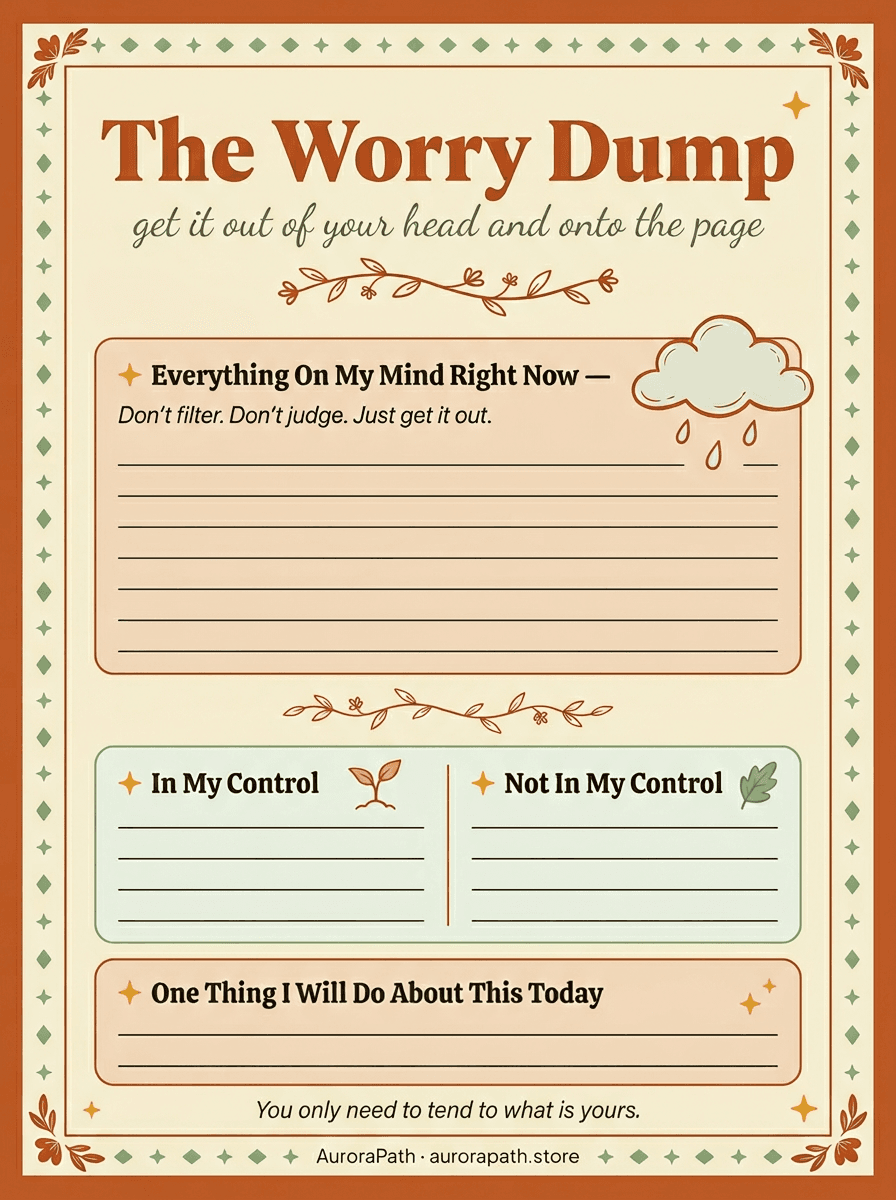
The worry externalisation technique. Ask your child to tell the worry out loud — or write it down — and then ask: is this happening right now, in this moment? Usually the answer is no. The worry is about tomorrow, or next week, or a possibility that may never occur. Naming this does not make the worry disappear but it does reduce its authority. The brain is generating a prediction, not reporting a fact.
The five things grounding exercise. Name five things you can see, four you can touch, three you can hear, two you can smell, one you can taste. This is not just a distraction technique — it is a deliberate redirection of attention to sensory present-moment experience that physically interrupts the anxiety loop by engaging the prefrontal cortex.
The worry time technique. Designate a specific ten-minute window each evening as worry time — when your child can worry freely about school-related things. When worries arrive outside of that window they acknowledge them — yes, I hear you, we will think about you at worry time — and set them aside. The brain learns that worries are not being ignored, just scheduled. This reduces the urgency that makes anxiety feel so overwhelming.
Mindfulness Tools for Performance Anxiety
Performance anxiety is particularly amenable to breathing-based interventions because the stress response is so physically immediate and breathing directly counters it.
Pre-performance breathing. Before a test, a presentation, or any high-stakes moment — three rounds of box breathing. In for four counts, hold for four, out for four, hold for four. This takes less than ninety seconds and measurably reduces cortisol. Teach it during calm moments so it is automatic when it is needed.
The body scan before performance. A quick thirty-second scan from head to feet noticing where tension is held — jaw, shoulders, stomach, hands. Deliberately relaxing each area. This is particularly effective for children who experience performance anxiety as physical symptoms — shaking hands, racing heart, tight chest — because it gives them something concrete to do with the physical experience rather than just enduring it.
The permission statement. A simple internal sentence the child says to themselves before a performance moment: I am allowed to find this hard. I am going to try anyway. This does two things — it validates the anxiety rather than fighting it, and it reconnects the child with their intention rather than their fear. It works especially well for perfectionistic children who interpret anxiety as evidence they are going to fail.
Mindfulness Tools for Social Anxiety
Social anxiety is the most complex of the three because it involves other people — which mindfulness cannot control. What it can do is help children manage their internal response to social uncertainty.
The kind observer perspective. When your child is caught in a social worry spiral — they said the wrong thing, someone is angry with them, they were left out — invite them to imagine how a kind friend would see the situation. Not a critical friend, not an anxious friend — a genuinely kind one. What would that person say about what happened? This perspective shift activates a different neural pathway than the self-critical spiral and often produces more balanced and accurate interpretations of social events.
The feelings first approach. Before problem-solving any social situation — validate the feeling completely. That sounds really painful. I can understand why you feel hurt. Children whose social worries are immediately met with advice or minimisation learn to stop sharing them. Children whose feelings are validated first share more, process more effectively, and are more receptive to support when it is eventually offered.
The social confidence anchor. Ask your child to remember a moment when they felt genuinely good in a social situation — when they made someone laugh, when a friendship felt easy, when they said exactly the right thing. Holding that memory deliberately before a socially challenging situation primes a different emotional state than entering it from a place of anxiety and self-doubt.
The After-School Decompression Window
One of the most practical things you can do for a child with school anxiety is protect the first twenty minutes after school arrival home.
No questions. No demands. No immediate debrief of the day. Just a snack and quiet time — their choice of activity, no screens if possible. This decompression window allows the nervous system to downregulate after the sustained demands of the school day before any new demands are introduced.
The conversations you want to have — about what happened, how they are feeling, what was hard — go much better after this window than before it. The child who needs ten minutes of quiet before they can talk is not being difficult. They are doing exactly what their nervous system needs.
After the decompression window a simple check-in question — what was the hardest part of today? — often opens more genuine conversation than any amount of direct questioning during that first twenty minutes.
A Note on When to Seek More Support
Mindfulness is genuinely effective for mild to moderate school anxiety. But if your child's anxiety is significantly interfering with school attendance, friendships, sleep, or daily functioning — or if it has been present consistently for several months without improvement — please speak to your GP or a child therapist.
Mindfulness works best as a complement to professional support when anxiety is severe, not as a substitute for it. Knowing the difference is one of the most important things a parent can do for an anxious child.
Related reading: a two-week back-to-school anxiety plan and what to say when your child is anxious.
Grow Calm's Learning to Breathe arc — Days 10 through 12 — focuses specifically on building a breathing toolkit that children can use anywhere, including at school. The Weathering Storms arc covers anxiety, worry, and fear with age-appropriate tools across six days of guided activities. Learn more at aurorapath.store/grow-calm.
From the AuroraPath Store
Grow Calm
A 30-day mindfulness challenge for kids aged 7–11. 96 beautifully illustrated pages — instant download.
$15.99
Get Grow Calm →Instant PDF download · Print at home
Alex Ewing
Creator of AuroraPath
Alex Ewing created AuroraPath to make premium mindfulness resources accessible for every family. Grow Calm is the first book in the AuroraPath collection.